Average siding replacement cost in Colorado, 2026
$19.15 / Sq Ft | $30,640 total
2,000 Sq Ft home / 1,600 Sq Ft siding area / James Hardie Primed 8.25" HardiePlank / 490 LF 3.5" HardieTrim / standard site access.
In this guide
The average cost of siding replacement in Colorado is $30,640 in 2026, or $19.15 per Sq Ft installed. This applies to an average 2,000 Sq Ft home with 1,600 Sq Ft of siding area, and includes full tear-off, housewrap, flashing, James Hardie Primed 8.25" HardiePlank, standard 3.5" trim, permit, and disposal.
If you prefer James Hardie ColorPlus, the factory-applied finish that eliminates field painting, expect $20.00–$22.50 per Sq Ft, or approximately $32,000–$36,000 on the same home. The difference is explained in detail below.
A note on our data: Most examples and charts in this guide use James Hardie fiber cement pricing, the product we install most, and where our cost data is most accurate. We have completed hundreds of Hardie installs across the Front Range using real job data. Vinyl and LP SmartSide ranges are included for comparison.
In this guide we break down:
- Realistic siding cost ranges for small, average, and large homes in Colorado
- What drives siding cost up or down, including hidden costs
- Cost of vinyl vs fiber cement vs engineered wood siding
- How siding style and exposure size affect total installed price
- When repair makes more financial sense than full replacement
- How to compare contractor estimates and bids properly
Watch: Siding Replacement Cost in Colorado (2026 Price Breakdown)
Prefer to watch instead of read? Here is the full cost breakdown in video form, covering the same price ranges, materials, and contractor questions we walk through below.
What Affects Siding Replacement Cost in Colorado?
There are 8 main factors that drive siding cost up or down on Colorado homes.
1. House Size and Wall Area
Larger exterior walls require more material and labor. That said, a larger house doesn't always mean more siding. Many Colorado homes have brick, stucco, or metal cladding that doesn't need replacement. Some of our customers have painted existing brick to complement new siding, reducing scope and cost while still getting a great result.
Rough estimate: siding area is typically 80% of home square footage for a standard two-story home, and less with brick, stone, or stucco accents.
2. Siding Tear-Off and Removal Costs
Full removal of existing siding down to the sheathing (the structural panels underneath your siding that everything attaches to) is the correct approach for the vast majority of installations. Tear-off, cleanup, dumpster rental, and landfill disposal cost approximately $2.35 per Sq Ft. Multiple existing siding layers add approximately $0.85 per Sq Ft per additional layer.
3. Moisture Protection and Flashing
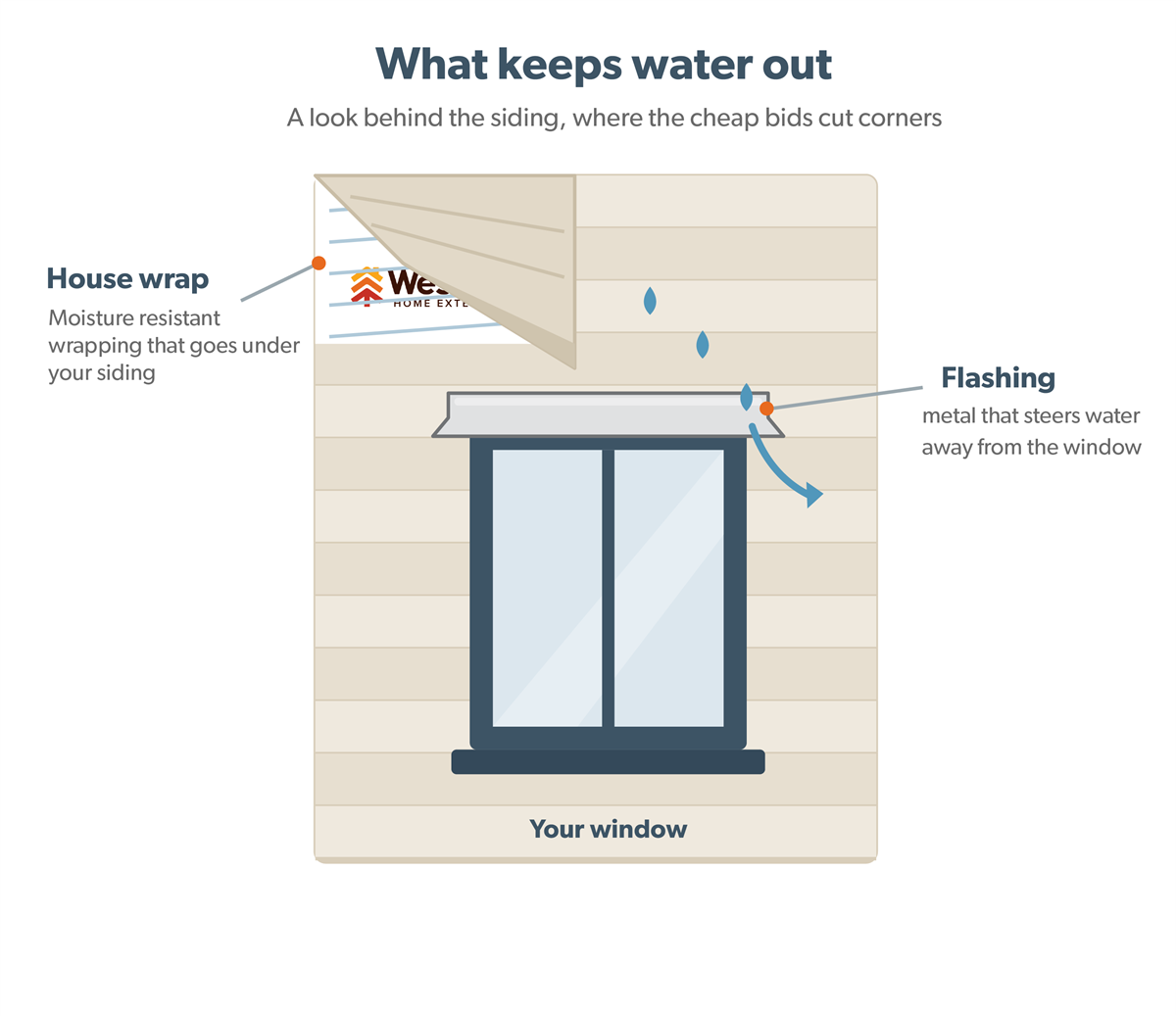
New housewrap (the weather-resistant barrier wrapped around the house before siding goes on), penetration wrapping, and metal Z-flashing (bent metal that channels water away from openings) above every window and door are critical to siding longevity and warranty compliance. This work is slow and labor-intensive, and it is the line item most commonly reduced on low bids. It is also the single most common cause of long-term siding failure.
4. Window and Corner Trim Detail
Standard 3.5" trim around windows, doors, and corners is included in most professional siding installations at $5.00 per lineal foot installed (a lineal foot is one foot measured in a straight line, which is how trim is priced). Wider accent trim, such as belly bands, frieze boards, and skirt boards (decorative trim at the mid-wall, top, and base of the home), costs more per foot and increases total project cost meaningfully.
Exterior Siding Trim Options and Costs
Based on 2,000 Sq Ft home / 1,600 Sq Ft siding area / 490 LF trim / Colorado 2026. Percentages calculated against average home midpoint of $34,000.
| Trim Size | Material Only (per LF) | Installed (per LF) | Total Project Cost Increase |
|---|---|---|---|
| 3.5" HardieTrim (standard) | $2.25 | $5.00 | Baseline |
| 5.5" HardieTrim | $3.60 | $8.92 | +5.6% (+$1,921) |
| 7.25" HardieTrim | $4.95 | $10.83 | +8.4% (+$2,857) |
| 11.25" HardieTrim | $7.50 | $15.25 | +14.8% (+$5,023) |
5. Home Height and Jobsite Access
Standard 1 vs 2-story height creates minimal cost difference when proper pump jack equipment is used (a pole-mounted scaffolding system crews stand on to reach upper walls). Where cost increases is difficult access: steep grades, rocky terrain, tight lots, or limited staging areas.
- Difficult site access: ~10–20% labor cost increase
- Easy-access suburban homes (Broomfield, Thornton, Westminster): ~5–10% less in labor vs difficult-access locations
Real project example: A home outside Lyons, CO had its backside built into a rocky cliff, so pump jacks couldn't be used on roughly half the structure. Total project cost increased by approximately 14% due to additional access labor and staging time. Similar situations occur regularly in Estes Park, Golden, Boulder foothills, and Summit County.
6. Siding Material and Style Options
The type of siding material and its exposure size both affect material cost and, critically, labor cost. Most pricing articles explain material differences but ignore labor implications entirely. See the detailed breakdown below.
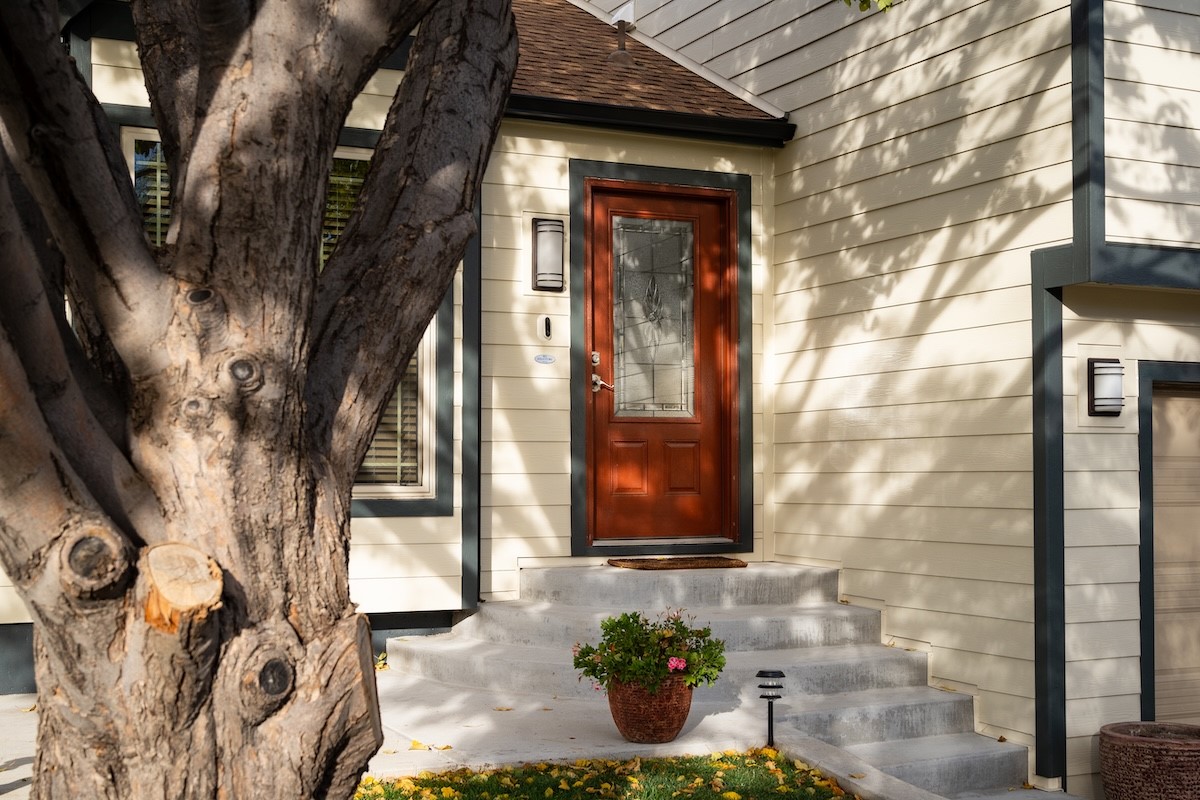
This Lafayette homeowner chose James Hardie lap siding in Navajo Beige. It's the most common look on the Front Range and the baseline for this guide, around $19.15 per square foot installed.
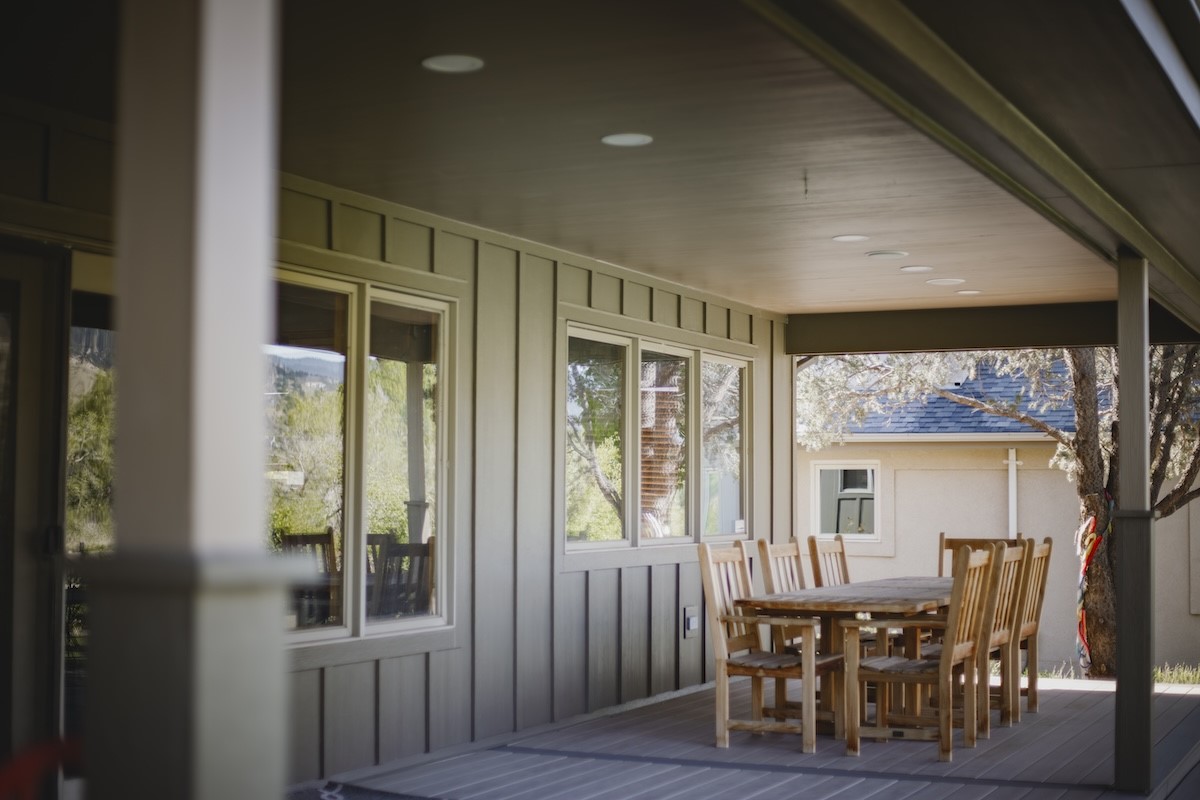
These Boulder homeowners chose a mix of siding styles. Featured here is their Hardie Board and Batten in Timberbark. The vertical boards and raised battens take more material and labor, running about $21.71 per square foot installed.
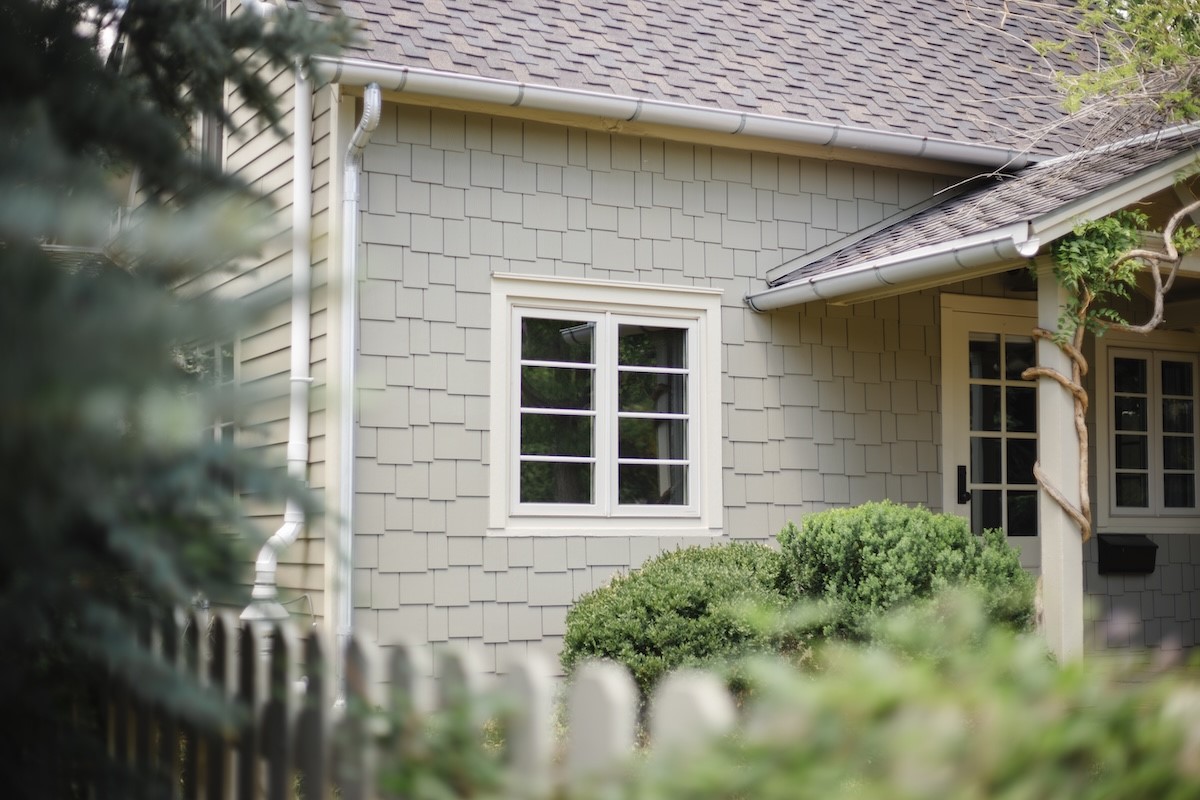
This Longmont homeowner chose Hardie shingle siding as an accent wall on the front of her home. This is primed Hardie siding, painted after installation with a light grey paint. This is the most labor-intensive profile at around $34.17 per square foot, which is why most homeowners use it on a gable, accent wall, or entry rather than the whole house.
7. Siding Installation Techniques
Blind nailing vs. face nailing: Hardie and LP SmartSide are designed to be blind nailed per manufacturer specification, meaning the nail is hidden under the next board. Face nailing, which drives the nail through the visible face, is faster but wrong. It voids warranties and creates moisture entry points at every nail head.
Rain screen installation: An air gap between housewrap and siding that improves drainage and drying performance. Adds approximately 8–15% to project cost. Worth discussing for high-moisture environments.
Caulking and joint treatment: All cut edges on fiber cement must be back-primed and sealed (the cut edge is sealed before install so it cannot soak up moisture). Rushing caulking at joints, corners, and penetrations is a leading cause of premature failure.
8. Hidden Costs
- Additional siding layers: +$0.85 per Sq Ft per layer removed
- Sheathing repair: $85–$110 per sheet installed, which cannot be determined without opening walls
- Permits: $250–$600 depending on municipality
Siding Replacement Cost Breakdown: Labor, Materials, Tear-Off and More
James Hardie Primed 8.25" HardiePlank / 2,000 Sq Ft home / 1,600 Sq Ft siding area / 490 LF 3.5" HardieTrim / standard access / Colorado 2026
| Cost Category | Total ($) | $/Sq Ft | % of Total |
|---|---|---|---|
| Tear-Off Labor, Dumpster & Disposal | $3,983 | $2.49 | 13% |
| Underlayment & Flashings | $3,677 | $2.30 | 12% |
| 3.5" HardieTrim, Material & Labor (490 LF) | $2,451 | $1.53 | 8% |
| HardiePlank 8.25" Lap, Material & Labor | $15,626 | $9.77 | 51% |
| Contractor Overhead, Insurance & Profit | $3,983 | $2.49 | 13% |
| Material Sales Tax | $613 | $0.38 | 2% |
| Permit | $306 | $0.19 | 1% |
| Total | $30,640 | $19.15 | 100% |
What this chart tells you: The siding itself, material and labor combined, is 51% of total cost. Tear-off and contractor overhead each come in at 13%. Underlayment and flashing is 12%, the line item most commonly cut on low bids, and the most common cause of long-term siding failure.
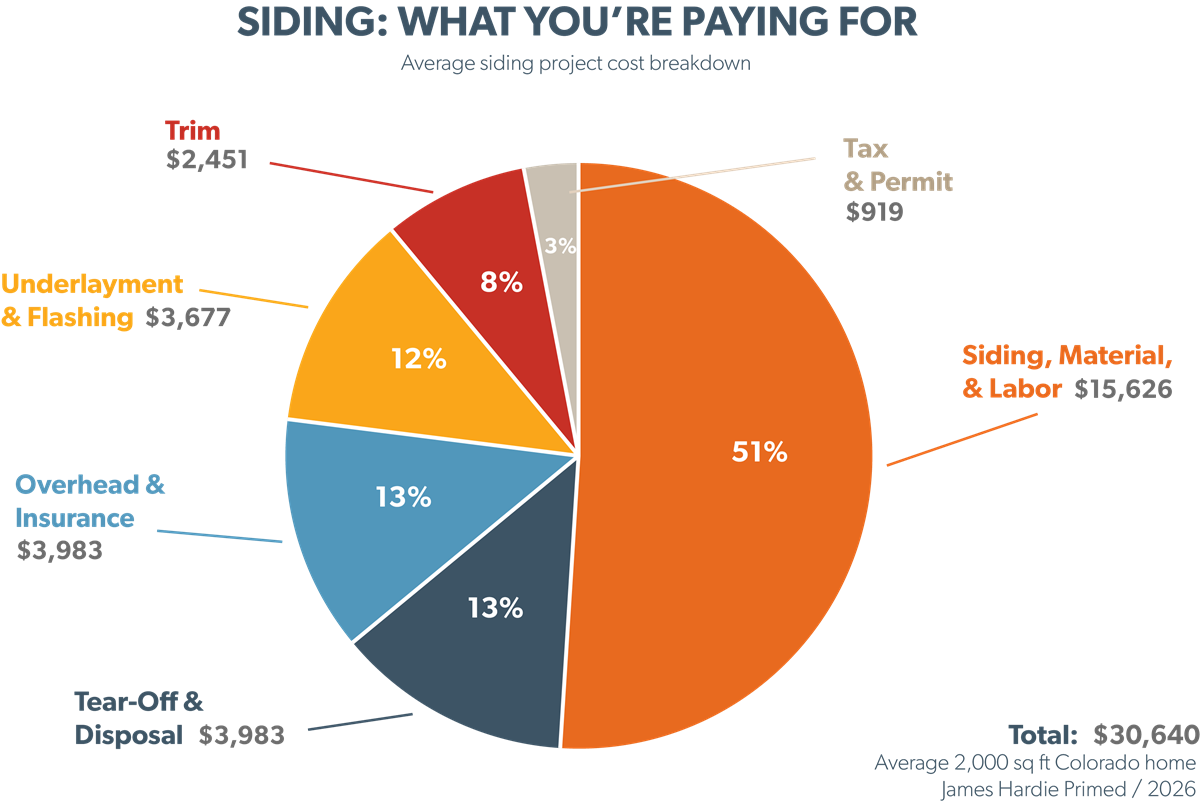
On contractor overhead and insurance: It is common in the siding industry for contractors to use subcontracted installation crews with little or no workers' compensation coverage. This reduces their bid price but transfers liability to you. If an uninsured installer is injured on your property, that liability can fall on the homeowner. Before signing any contract, confirm that there are certificates of insurance for both the company and the installation crew.
Want a number for your actual home, not an average?
We'll measure it and give you a real price. No pressure, no obligation.
Get a free quoteColorado Siding Replacement Costs in 2026: Vinyl vs LP SmartSide vs James Hardie
All pricing includes full tear-off, housewrap, flashing, standard trim, labor, permits, and disposal. Reflects Primed finish for Hardie and LP SmartSide. Factory finish (ColorPlus / LP Pre-Finished) adds approximately $1.25–$1.60/Sq Ft.
| Home Size | Siding Type | Home Sq Ft | Siding Area | Price/Sq Ft | Total Cost |
|---|---|---|---|---|---|
| Small | Vinyl (Mastic) | 1,600 | 1,400 Sq Ft | $14.50–$17.00 | $20,300–$23,800 |
| Small | LP SmartSide | 1,600 | 1,400 Sq Ft | $17.00–$20.00 | $23,800–$28,000 |
| Small | James Hardie | 1,600 | 1,400 Sq Ft | $18.57–$20.71 | $26,000–$29,000 |
| Average | Vinyl (Mastic) | 2,000 | 1,600 Sq Ft | $14.50–$17.00 | $23,200–$27,200 |
| Average | LP SmartSide | 2,000 | 1,600 Sq Ft | $17.00–$20.00 | $27,200–$32,000 |
| Average | James Hardie | 2,000 | 1,600 Sq Ft | $18.75–$21.25 | $30,000–$34,000 |
| Large | Vinyl (Mastic) | 3,000 | 2,500 Sq Ft | $14.50–$17.00 | $36,250–$42,500 |
| Large | LP SmartSide | 3,000 | 2,500 Sq Ft | $17.00–$20.00 | $42,500–$50,000 |
| Large | James Hardie | 3,000 | 2,500 Sq Ft | $18.40–$20.00 | $46,000–$50,000 |
Standard vinyl occupies the lower end of the vinyl range. Premium vinyl composites such as Alside Ascend, a co-extruded polymer (a vinyl built in two bonded layers for extra strength) with meaningfully better dimensional stability and impact resistance than standard PVC, can approach the upper end and overlap with LP SmartSide pricing. Ask your contractor exactly which vinyl product is being proposed.
A few things worth noting from the comparison above. The gap between vinyl and James Hardie fiber cement siding narrows on larger homes. This is not because Hardie gets cheaper, but because the fixed costs of mobilization (what contractors like us call "getting the job ready"), disposal, and contractor overhead spread across more square footage. LP SmartSide consistently lands $3,000–$5,000 below Hardie on an average home, and that gap represents real differences in fire resistance, dimensional stability, and long-term track record, not just brand premium. Vinyl, while the lowest installed cost, carries meaningful performance tradeoffs in Colorado's climate. It simply does not hold up as well to hail impact, temperature swings, fire risk, and UV exposure, which we cover in detail in our James Hardie vs LP SmartSide comparison guide.
Siding Style Options and How They Change Your Total Price
Most homeowners assume a smaller siding exposure just means a different look. It doesn't. It changes the math of the entire installation.
Standard 8.25" lap siding provides 7" of exposure. A 5.25" profile provides 4" of exposure, covering significantly less wall per board. In practical terms:
- Material cost per Sq Ft increases roughly 23%
- Installers must handle 75% more courses of siding to cover the same wall
- Labor efficiency drops significantly, typically a 40–60% increase in installed labor
Siding Style and Exposure Cost Comparison, Average Home
Primed HardiePlank / 2,000 Sq Ft home / 1,600 Sq Ft siding area / standard access / Colorado 2026. All prices Primed finish.
| Profile | Installed $/Sq Ft | Total Project Cost | vs 7" Baseline |
|---|---|---|---|
| 7" Exposure, 8.25" HardiePlank (Baseline) | $19.15 | $30,640 | Baseline |
| 4" Exposure, 5.25" HardiePlank | $24.71 | $39,536 | +$8,896 / +29% |
| Board & Batten, HardiePanel + 2.5" Batten | $21.71 | $34,736 | +$4,096 / +13% |
| HardieShingle (accent use)* | $34.17 | $54,672 | +$24,032 / +78% |
*HardieShingle is rarely installed whole-house. Typical applications are accent areas of 150–300 Sq Ft. Full-home pricing shown for comparison only.
If a bid shows 4" exposure siding priced the same per square foot as standard 7" exposure, that contractor either hasn't done the math or isn't sharing it with you.
Siding Repair vs. Replacement: How to Decide
Repair may make sense when:
- Damage is isolated and the rest of the siding system is structurally sound
- No moisture has penetrated the wall assembly behind the damaged area
- The existing material can be responsibly matched and the repair will hold
- Resale is not a near-term factor
Full replacement is typically the right call when:
- Moisture intrusion is confirmed. The single strongest indicator. Spot repair addresses the surface, while the wall damage continues underneath.
- The existing product cannot be reliably repaired. Older engineered wood products like original LP hardboard and Masonite have well-documented failure patterns.
- You are preparing for resale. Partial repairs on aging siding raise more questions than they answer for buyers and inspectors.
- Fire protection is a factor. For foothills homeowners in Boulder, Golden, Fort Collins, Estes Park, and surrounding areas, replacing combustible siding with non-combustible fiber cement is a meaningful risk reduction decision. Insurance carriers in high fire-risk zones are increasingly aware of this distinction.
- Paint costs make replacement the better ROI. A full repaint on a 2,000 Sq Ft Front Range home runs $8,000–$15,000 and needs repeating every 10–15 years. When aging siding also needs repairs before painting, the combined cost often approaches new fiber cement with a factory finish warranty. This math has shifted significantly as paint costs have risen.
A good contractor will recommend repair when repair is the right answer. If every contractor you talk to recommends full replacement on a home where repair is genuinely sufficient, that is worth paying attention to.
Realistic Cost Examples: Colorado Siding Replacement Projects
These are not actual completed projects. They are realistic examples built from real installed pricing data.
| Project Type | Scope | Estimated Cost | $/Sq Ft |
|---|---|---|---|
| Longmont Production Home | 2,000 Sq Ft home / 1,600 Sq Ft siding / Hardie ColorPlus / standard access | $32,000–$36,000 | $20.00–$22.50 |
| Boulder Foothills Custom Home | ~2,800 Sq Ft home / 2,200 Sq Ft siding / Hardie ColorPlus / difficult access / multiple roof tie-ins | $52,000–$62,000 | $23.50–$28.00 |
| Fort Collins HOA Multi-Building | 12,000 Sq Ft total siding / LP SmartSide Pre-Finished / standard access | $204,000–$240,000 | $17.00–$20.00 |
All examples assume standard tear-off, housewrap, flashing, trim, permits, and disposal. Actual costs vary by scope and site conditions.
How to Compare Siding Contractor Estimates and Bids
Professional siding companies generally present a clean total, not a line-item spreadsheet. That is not hiding anything. What matters is whether the contractor can clearly answer the right questions and whether those answers are in the contract.
Ask before signing:
- What is included in tear-off? Full removal to sheathing should be standard. Confirm it explicitly, because some bids are priced for installation over existing siding.
- What housewrap product is being used, and is it fully replaced? Confirm it is vapor-permeable (it lets moisture escape from inside the wall while blocking it from outside) and fully integrated at all penetrations (any opening in the wall, such as a pipe, vent, or outlet).
- How are windows, doors, and penetrations flashed? Z-flashing and penetration flashing should be standard. If the contractor can't describe the process specifically, note it.
- Are roof tie-in areas being addressed? Where siding meets rooflines (the spots called roof tie-ins), specific flashing corrections are required. Ask how they are handled.
- Are installation crews covered by workers' compensation? Request certificates of insurance for both the company and the crew.
- What happens if the dumpster fills? Some contracts pass additional disposal costs to the homeowner. Confirm disposal is fully included.
- What is the labor warranty? Get it in writing. Understand what it covers and for how long.
On a standard 2,000 Sq Ft Front Range home, bids from legitimate professional contractors typically vary by $3,000–$6,000. A gap significantly larger than this usually means the bids are not covering the same scope.
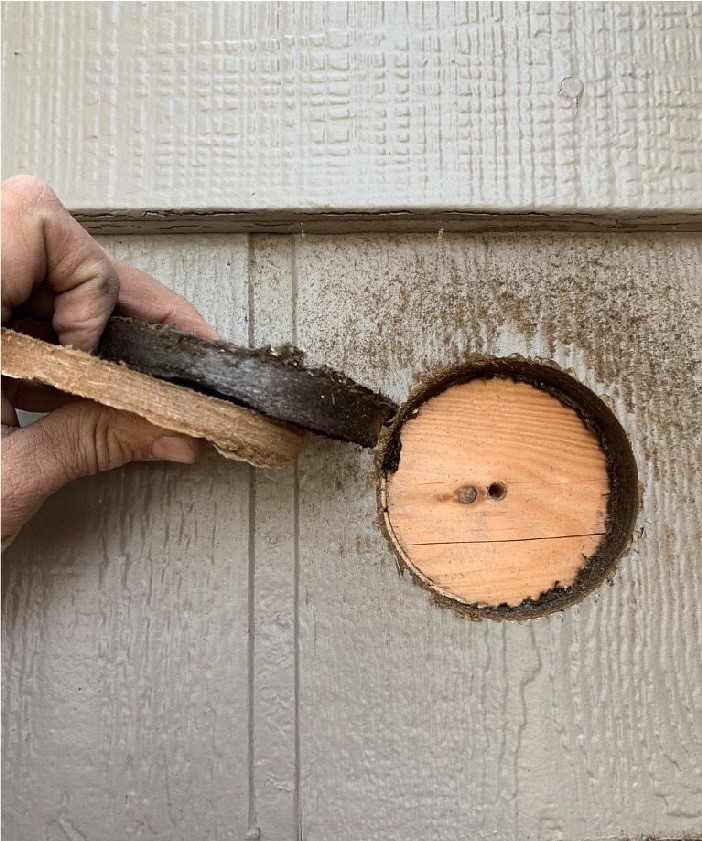
Something we do that most contractors don't: Before starting any project, we conduct a pre-construction meeting at your home: re-measuring, confirming scope in person, and performing a core test by drilling small holes to analyze sheathing type and condition before any siding is removed. If the core test reveals a problem, we address it in a change order before work begins. You see the full picture before you're committed.
We once discovered during a core test that an entire home had fiberboard sheathing, which is not suitable for a Hardie installation. We disclosed it before starting, agreed to delay the project, and completed the work when the homeowner was ready, saving him thousands by waiting for sheathing costs to normalize. Ask any contractor you're evaluating how they handle sheathing discoveries. The answer tells you a great deal about how they operate.
What a Core Test Actually Looks Like ↓
Frequently Asked Questions
How much does siding replacement cost in Colorado in 2026?
For an average 2,000 Sq Ft home, James Hardie primed siding runs about $30,640, or $19.15 per Sq Ft installed. That includes full tear-off, housewrap, flashing, trim, permit, and disposal. The ColorPlus factory finish runs roughly $32,000 to $36,000 on the same home.
Is James Hardie worth more than vinyl or LP SmartSide?
Hardie typically costs $3,000 to $5,000 more than LP SmartSide on an average home, and more than vinyl. The added cost reflects stronger fire resistance, dimensional stability, and long-term performance in Colorado's climate, where vinyl struggles with hail, temperature swings, and UV exposure.
Should I repair or replace my siding?
Repair can make sense for isolated damage when no moisture has reached the wall behind it. Full replacement is usually the right call when moisture intrusion is confirmed, the existing product cannot be reliably matched, you are preparing to sell, or fire protection is a priority in foothills areas.
What is the most common cause of siding failure?
Cut corners on moisture protection. Underlayment and flashing make up about 12% of project cost and are the line item most often reduced on low bids. They are also the most common cause of long-term siding failure.
Does siding style affect the price?
Yes, significantly. A narrower exposure means more boards and more labor to cover the same wall. A 4" exposure can add roughly 29% to total cost versus standard 7" lap siding, and board and batten adds about 13%.
What should I ask a siding contractor before signing?
Confirm what tear-off includes, which housewrap is used and whether it is fully replaced, how windows and penetrations are flashed, whether crews carry workers' compensation, and what the labor warranty covers. Bids on the same scope usually vary by only $3,000 to $6,000.
What is a core test?
A core test is when small holes are drilled before siding removal to check the type and condition of the sheathing underneath. It lets any problem get addressed in a change order before work begins, so there are no surprises mid-project.
Thanks for reading.
If you want an exact price for your home, we'll measure it and give you a real number. No pressure.
WestPro Home Exteriors | 164 Primrose Ct. Longmont, CO | 303-834-9236 | info@westproroofing.com
About This Article: Pricing data derived from real siding replacement projects completed by WestPro Home Exteriors in Longmont, Louisville, Fort Collins, and Denver, CO in 2025 and early 2026. Current 2026 estimate templates and material pricing from ABC Supply Co. and QXO (formerly Beacon Supply). Some supplementary data from XactAnalysis (Xactimate) pricing for Denver and Boulder County.
About the Author: Written by Patrick Knackendoffel, Founder and President of WestPro Home Exteriors in Longmont, CO. Siding and roofing professional since 2011.
About WestPro Home Exteriors: Licensed and insured roofing, siding, and window replacement contractor in Longmont, CO. James Hardie Elite Preferred Contractor. GAF Master Elite Roofing Contractor. Serving Longmont, Boulder, Denver, Fort Collins, Loveland, Estes Park, and the surrounding Front Range.
Tags
Subscribe to WestPro's Blog


Comments